The Platform
The analyst’s loop, end to end.
Collect. Correlate. Fuse. Test. Record. Every step is traceable, and every claim in the final summary carries the graded evidence beneath it.
-
Collect
Set an area of interest — a place name, coordinates, or an MGRS grid — and pull in the feeds your team is granted: vessels, aircraft, earthquakes, weather and more. An administrator can define a new feed from a form, no code; a dry run shows exactly what will be imported before anything is saved. Upload documents to extract entities of interest without AI, using deterministic, repeatable rules you can trace end to end.
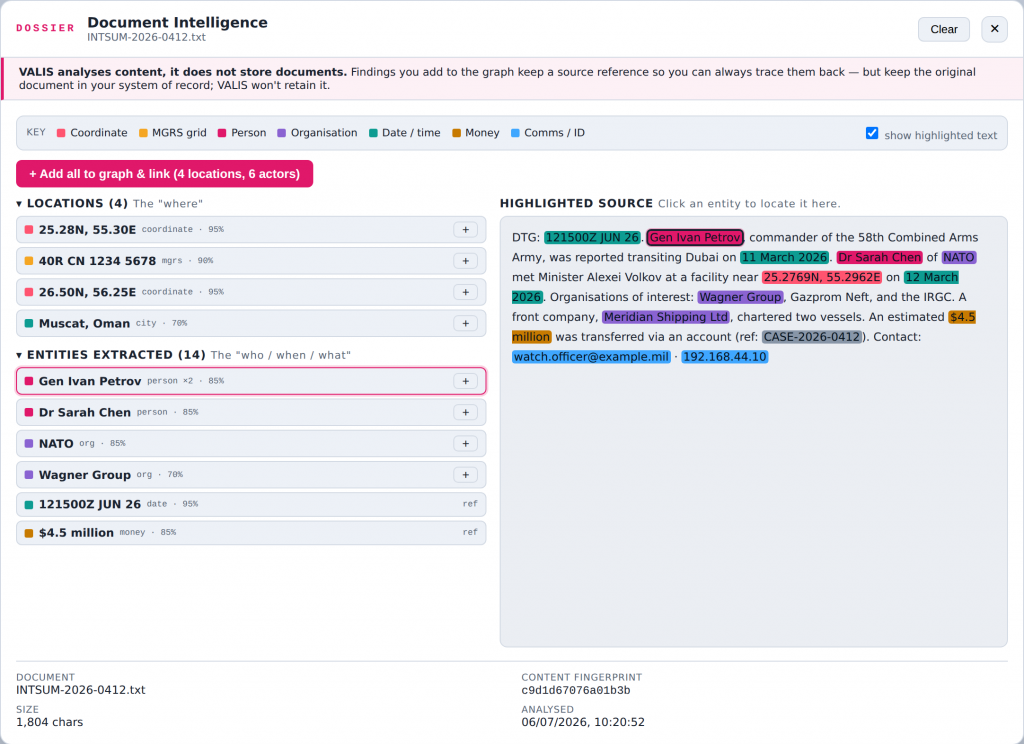
Upload document content to extract entities of interest without the use of AI — using deterministic, repeatable rules you have full transparency on. -
Correlate
The correlation engine finds meaningful pairings across your entities — close in space, close in time, co-incident — plus density clusters and same-entity resolution, so the map starts telling you where to look.
-
Fuse — convergence across sources
Fusion runs pattern-of-life over movement and computes multi-source convergence: where several independent sources agree that something is happening. Agreement across sources is the signal that outranks any single feed.
-
Test your own judgement
Analysis of Competing Hypotheses lays every plausible explanation side by side and scores the evidence against all of them — the analytic opposite of cherry-picking. It is built to challenge your assessment, not flatter it.
-
Record
VALIS assembles your work into a structured written summary and a briefing deck that record how each conclusion was reached. Every indicator traces back to the evidence that produced it.
Deliberately deterministic
The output is defensible because the method is.
Every one of those steps is deterministic: given the same data, it gives the same answer, and it can always show its working. The document analysis runs on rules, not a model — nothing is invented, nothing is hallucinated.
That is what makes the output defensible. When someone asks “how do you know?”, the answer is on the screen: this evidence, graded this way, correlated by this rule, producing this indicator.
The house rule. AI is allowed to describe a picture you have already built — never to invent one. Every finding traces back to the rule that produced it.
A note on where this sits
Software that correlates open-source signals into a geospatial picture sits close to a live and legitimate debate about automated decision support and the role of AI in military targeting. Airwars’ work on this is worth reading, and it is part of why VALIS is built the way it is: deterministic rules rather than a model, an evidence trail behind every claim, and no automated recommendation of any action against anything.
VALIS is a research demonstrator. It is not a targeting system, it does not produce target nominations, and it is not offered for operational use.