See the whole picture.
Prove every line of it.
VALIS is a working demonstrator that turns scattered open-source signals into a traceable analytic picture — collected, correlated, reasoned over, and recorded with its evidence trail intact. It was specified, tested and debugged end to end without hand-written code, and it exists to answer one question about that method: can you prove what it produced?
What it is
A geospatial analysis workbench.
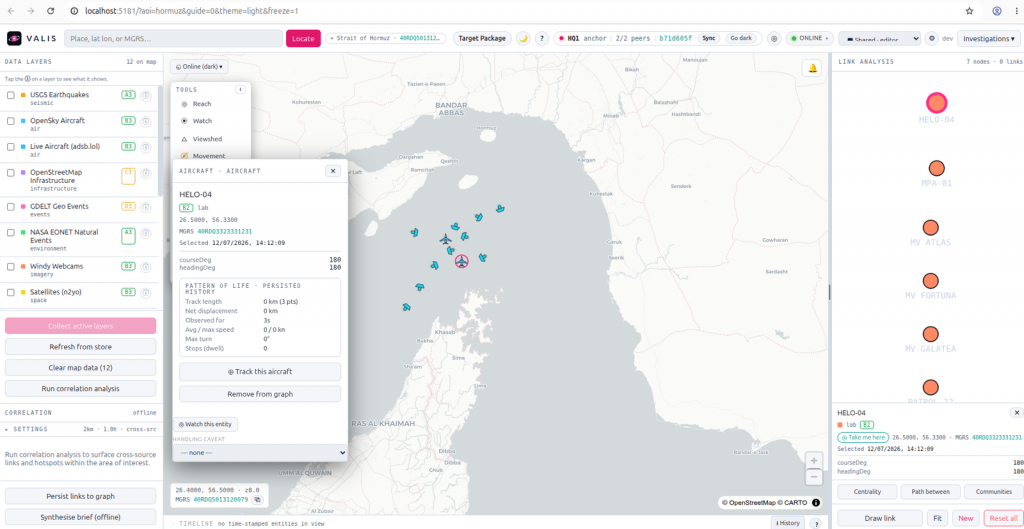
VALIS gathers open data from many feeds onto a single map, helps you understand it with analysis that can be explained line by line, keeps the reasoning traceable, and assembles the result into a structured written summary — with the evidence trail intact behind every claim.
It was built against the constraints real analytic work runs into: teams rather than lone operators, unreliable links rather than guaranteed connectivity, and scrutiny — because the interesting question about any AI-assisted system is “how do you know?”
The analysis runs on deterministic rules, not a machine-learning model. The same data always gives the same answer, and every finding traces back to the rule that produced it. AI is allowed to describe a picture you have already built — never to invent one.
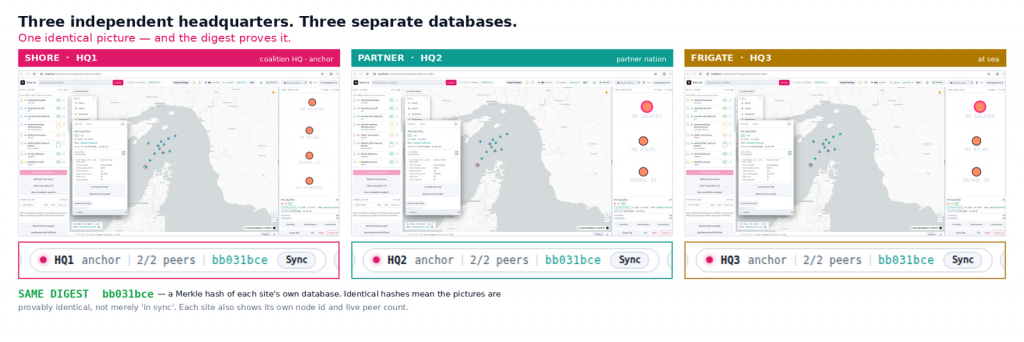
Three independent sites each run a complete VALIS with their own database, and converge on one shared picture. No central server to lose. And each site can prove it holds the same picture.
A site can lose its link entirely and keep working. When it comes back, everything reconciles in both directions with no data loss. Losing a link costs you convenience — never data.
At rest, in transit, and per sensitive field — encrypted before it ever reaches the database. A stolen disk or a compromised database account yields ciphertext, not readable data.
Runs on your own infrastructure with an open-source datastore. No per-seat cloud dependency, no data leaving the machine. Runs fully air-gapped, including the document analysis.
Every claim on this site maps to a command you can run and a test that prints PASS or FAIL. Nothing is asserted that the code cannot demonstrate.
Interoperability · NATO data standards
Speak NATO. Prove it in one command.
An analytic picture is only useful if the next system can read it. VALIS gathers and shares data in the formats NATO systems already use — and, in the VALIS tradition, the conformance isn’t asserted. A single command runs the standards test suite against real code and prints PASS or FAIL for every one.
Ingest a track picture as NVG (1.5–2.0.2), shapes as KML, features as GeoJSON — symbology decoded to APP-6 / MIL-STD-2525, positions to MGRS.
Re-emit any layer as conformant NVG or KML for the next system — every artefact carrying a STANAG 4774 confidentiality label a recipient can enforce.
Before anything leaves, a releasability egress gate checks clearance and nationality against the label. A mismatch is blocked — not merely marked.
Put plainly. “Conformant” here means VALIS reads and writes each format correctly, proven by test vectors, in software. Tested interoperability with a specific partner system, and formal accreditation, are separate things beyond this — and this site labels which is which rather than blurring them.
Proven, not asserted
We would rather show you than tell you.
VALIS’s federation is proven, not asserted. A single command rebuilds three independent sites and runs twelve adversarial acts against them — killing a site mid-run, forcing two analysts into contradictory assessments, cutting links. Each act asserts a specific fact against three real databases and prints PASS or FAIL.
Nothing on this site is claimed that the code cannot show.
What this project is, and what it isn’t
What it is
- A research demonstrator, built on personal time, to test how far AI-assisted development can go on a large standards-conformant system.
- An exercise in making analytic reasoning auditable — deterministic rules, reproducible outputs, and a test suite that prints PASS or FAIL.
- A body of evidence about a method. The method is the finding, not the software.
What it isn’t
- A product. Nothing here is for sale, licence, hire or deployment, and no demonstrations are being offered.
- Accredited, assured or approved by any government, department or agency, and not represented as suitable for operational use.
- Tested against any specific partner system. Standards conformance is proven in software against test vectors; interoperability and accreditation are separate things, and this site does not blur them.